

Introduction
Systematic reviews in medicine grind research momentum to a halt. You spend months screening thousands of studies across scattered PDFs, manually extracting data into spreadsheets while praying your inter-rater reliability holds up. It is tedious, expensive, and a single missed study can invalidate your entire synthesis. Traditional platforms like Covidence help organize the mess, but they often leave you doing the heavy lifting manually or fighting with clunky interfaces.
The rise of AI offers a tempting shortcut to cut that timeline down from six months to six weeks, but it introduces a terrifying new variable - hallucinations. In clinical research, you cannot afford a language model inventing a sample size or fabricating a confidence interval. You need automation that respects HIPAA compliance and keeps data local, not just another cloud subscription. We compared Fynman, Covidence, and Rayyan to see which tool actually delivers rigorous PRISMA workflows without sacrificing data privacy or accuracy.
The Hidden Cost of Manual Data Extraction
Screening gets the credit, but extraction steals your time. While tools like Rayyan expedite the title and abstract phase, they barely scratch the surface of the actual workload - handling roughly 20% of the effort. The brutal reality is that compressing your timeline from six months to six weeks depends entirely on automating the full-text data entry phase, not just filtering citations.
Once you pass the screening gate, you are left manually copying hazard ratios, confidence intervals, and demographic tables from thousands of PDFs into spreadsheets. This manual transcription is where the bottleneck actually exists, and it is prone to human error that compounds over large datasets. When a researcher spends an estimated 37% of their billable hours on this mechanical task rather than analysis, the inefficiency costs the lab roughly $31,450 annually in wasted productivity. You are paying for high-level expertise to perform low-level clerical work. Optimizing your tool stack to address only screening ignores the elephant in the room - the real bottleneck starts the moment you decide to include a study.
The Three-Tool Shuffle: Why Your Current Workflow Fails

Most researchers start with Rayyan because it handles the initial screening dump well. But once you hit the full-text review, Rayyan hits a wall. You move your project to Covidence for the PRISMA tracking, thinking it will centralize everything. It does not. Covidence organizes the workflow, but it still forces you to manually read and type every data point into a web form.
Eventually, you abandon the form and export everything to Excel.
Now you are trapped in a three-tool shuffle. You screen in Rayyan, manage in Covidence, and extract in Excel. Every transfer between these platforms introduces risk. You export an RIS file, import it, and hope nothing breaks in the translation. A tag gets dropped. A reference ID mismatches. You lose the audit trail every time you hit “Export,” and recreating it is a nightmare.
The cognitive load is the real killer here. You are constantly switching interfaces. One minute you are blind-screening in a web portal, the next you are hunting for a specific cell in a massive spreadsheet. This friction destroys your ability to hold complex clinical data in your head. Instead of focusing on the synthesis, you are debugging your own workflow. You waste mental energy on file formats and import errors instead of evaluating the evidence. Your brain spends more time navigating the logistics of the review than actually interpreting the results.
This fragmentation also makes accuracy impossible to enforce. When you are copy-pasting numbers between three different systems, you have no way to automatically flag a discrepancy. If you type “4.5” instead of “0.45” in Excel, there is no safety net. The disconnection between your screening tool and your extraction tool means you are building your clinical synthesis on a pile of loose, unverified data points. It is not just inefficient - it is a liability waiting to happen.
When AI Mistakes Become Clinical Malpractice
Large language models are pattern matchers, not truth engines. In a clinical systematic review, that distinction is fatal. When you ask a generic AI to extract a hazard ratio or a p-value from a PDF, it is not reading the table the way a human does. It is predicting what looks statistically probable based on the millions of medical papers it has digested. When it hallucinates a confidence interval, it does so with high conviction. This is not a typo. It is a structural failure.
The danger compounds quickly. If you accept a fabricated number into your dataset, you corrupt the entire synthesis. A single fake hazard ratio can skew the pooled effect size significantly enough to flip a clinical recommendation. That flawed recommendation ends up in a treatment guideline. A clinician reads that guideline and prescribes a therapy that is ineffective or actively harmful. At that point, your review isn’t just a bad paper - it is a liability. The stakes are not abstract grades or reviewer feedback. They are patient outcomes.
We call this the “traceability gap.” It is the distance between the data point you see in your CSV and the reality inside the PDF. In a manual workflow, that distance is zero because you typed it yourself. With a black box AI, that distance is infinite. Most AI tools extract data into a spreadsheet but refuse to show you the exact pixel or sentence in the source PDF where that number originated. This forces you to either trust the machine blindly or manually re-check every single data point, defeating the purpose of automation. You cannot audit the logic. You cannot verify the source.
This gets worse when you consider how messy medical PDFs actually are. Poorly scanned tables, merged cells, and supplementary appendices confuse standard models. The model sees a number near the word “mortality” and assumes a connection, ignoring the footnote that says “post-hoc analysis excluded.” Without a direct tether to the source text, the AI might be pulling a number from the wrong row or a different study entirely. Real rigor requires a chain of custody for every data point. If the tool cannot point to the exact page coordinate and quote the source text, it has no place in high-stakes medical research.
The IRR Nightmare: Tracking Disagreements Without Losing Your Mind
A Cohen’s Kappa of 0.4 is where projects go to die. This is the IRR nightmare. You know you need to resolve conflicts to move to extraction, but the tools fight you. Covidence and Rayyan flag the disagreement, but actually digging into why you voted include and your collaborator voted exclude often feels like detective work with a broken magnifying glass.
Blind screening protocols are supposed to prevent bias, yet maintaining that separation during the resolution phase is surprisingly clumsy. If you resolve conflicts without strict blinding, you risk anchoring. You convince your partner to change their vote simply because you argued louder, not because the evidence supports it. Most traditional platforms handle this by forcing you out of the app to discuss findings, breaking the workflow. You end up in a separate Slack thread arguing over exclusion criteria rather than making a definitive decision in the software.
Standard spreadsheet workflows fail here completely. They cannot track who voted for what without exposing all votes immediately, making true blind resolution impossible. This friction is the primary bottleneck between screening and extraction. You might spend weeks reconciling disagreements on a mere 2% of your studies while the remaining 98% sit waiting in limbo. The tool that should be accelerating your review becomes the very reason you miss your submission deadline. By the time you actually agree on the final list, the momentum is dead, and you are already dreading the next phase.
The Cloud Data Trap: Why Universities Are Blocking Covidence
Just when you have your screening workflow optimized, your institution’s IT department slams the brakes. It happens constantly. You try to set up a team account on a cloud platform like Covidence, but the procurement office rejects the request over compliance concerns. This is not bureaucratic red tape for its own sake. It is a direct response to GDPR and HIPAA liabilities that threaten institutional funding and reputation.
The friction point is data sovereignty. The moment you upload a PDF containing unpublished trial results or individual patient data (IPD), you effectively export that data outside your university’s firewall. Most cloud-based review platforms do not offer data processing agreements that satisfy strict university legal teams. If a vendor suffers a breach, your sensitive clinical data becomes a massive legal liability for the university, not the software provider. For medical researchers, this creates an impossible choice - violate university policy to use efficient tools, or adhere to policy and grind your workflow to a halt.
Then there is the silent trap of vendor lock-in. Many cloud platforms host your project data on their servers, effectively holding it hostage. You are handing over the intellectual property of your synthesis to a third party. If your grant funding runs dry or your lab changes affiliation, and you cannot renew the annual subscription, you risk losing access to your own extracted data, tags, and conflict resolutions. You cannot afford to gamble your PhD timeline on a software subscription. You need a workflow where the data resides on your local machine, ensuring you retain total ownership regardless of subscription status or institutional policy shifts.
Fynman vs. Covidence: Automating the Extraction Phase
Covidence organizes your workflow, but it forces you to act as a data entry clerk. It is excellent for management - screening studies and resolving conflicts - but it treats the extraction phase like a digital notebook. You build a rigid form, assign reviewers, and then manually transcribe data from PDFs into text boxes. You are constantly context-switching between the document and the browser, a repetitive motion that breeds fatigue and invites typos in critical numbers like p-values or standard deviations.
Fynman removes the manual transcription layer. Instead of asking you to find and type the data, it parses the PDF structure to identify tables and figures automatically. It extracts baseline characteristics, intervention details, and outcome measures into a unified view. You are not generating data from scratch - you are auditing the AI’s work. This shift is subtle but profound. It reduces the cognitive load of remembering which column corresponds to which variable, allowing you to focus on the scientific validity of the content rather than the mechanics of entry.
The advantage compounds when you handle non-standardized data. In Covidence, extracting time-to-event data from a Kaplan-Meier curve requires you to eyeball the graph and estimate coordinates at specific intervals. It is inherently imprecise. Fynman reads the curve geometry directly, calculating survival probabilities and hazard ratios from the image data with a precision that manual estimation cannot match. It turns a visual approximation into a calculable data point.
However, the system is not immune to the quality of your source material. The automation hits a wall with low-quality scanned PDFs, which are common in historical reviews or older retrospective studies. If the OCR text is garbled or the table cells are merged into an unreadable image, the AI cannot distinguish a “5” from an “S” or a “6” from a “b”. In these cases, you must manually override the extraction or type the data yourself. The speed gains evaporate on these specific files, forcing you to treat them as exceptions rather than the rule. For modern, digital-first literature, though, this workflow collapses weeks of extraction into days.
Zero-Hallucination Architecture: Tracing Every Number to a Pixel
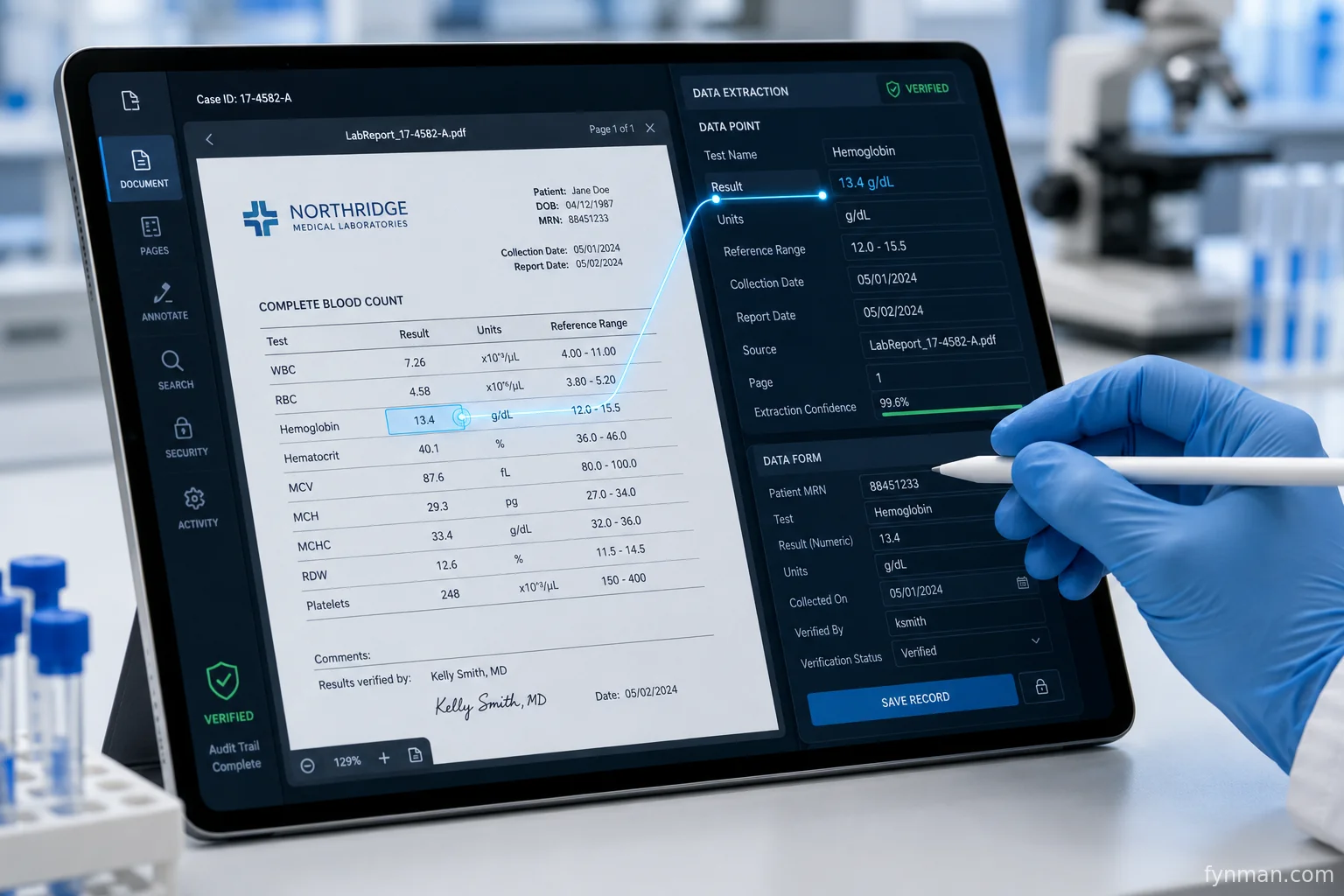
The term “zero-hallucination” gets thrown around a lot, but in medical research, it has to be an engineering constraint, not a marketing slogan. You cannot simply hope the model gets a confidence interval right. Fynman solves this by refusing to extract data in a vacuum. Every number the AI pulls from a paper is hard-linked to the exact page coordinate and source text in the underlying PDF. If the system tells you the mortality rate is 12%, it does not just generate that figure. It highlights the specific sentence in the results section where it found that data, showing you the pixel-level context. This turns the extraction process from a guess into a traceable audit trail.
This architecture creates a “Verify Loop” that fundamentally changes your role. Instead of hunting through a 50-page PDF to find a single p-value, the system finds it for you and brings it to your cursor. The AI proposes the data, but the workflow forces a manual checkpoint. You see the extracted number alongside the source text. You verify that the control group matches the intervention group and that the standard deviation is actually for the mean you care about. Only then do you accept the entry into your dataset. You move from being a data entry clerk to a data auditor. It feels faster because the cognitive load of searching is gone, but the rigor remains because the final decision stays with you. This loop effectively eliminates the fabrication risk inherent in black-box models. The model cannot hallucinate a number without simultaneously hallucinating a fake location in the PDF, which is significantly easier for you to spot than a wrong number in a spreadsheet cell.
However, traceability does not mean blind trust. The system works beautifully on standard publications, but real-world literature is messy. You will encounter legacy papers where tables are scanned images or layouts use complex merged cells that confuse even the best vision models. In these edge cases, the link might break or the coordinate might drift. The software flags these low-confidence extractions, but you still have to spot-check them manually. Zero-hallucination means the tool never lies about where it found a number - but it also means being honest when it can’t read one. You still need to review the difficult tables yourself to ensure your synthesis is bulletproof.
Local-First Privacy: Keeping Your Data on Your Device
Fynman processes your entire systematic review locally on your device, meaning your raw PDFs and extracted data never leave your control. Unlike Rayyan or Covidence, which require uploading your full text to third-party cloud servers for screening and analysis, Fynman runs the AI models directly on your hardware. This architectural difference isn’t just a technical preference - it is the only way to bypass the institutional purchasing red tape that kills momentum.
When you try to use a standard cloud platform for clinical research, you immediately trigger a procurement review. Your IT department must verify GDPR and HIPAA compliance, negotiate data processing agreements, and assess vendor security posture. This process often takes months. With Fynman, there is no vendor server to assess because you simply download the application and start working. The data stays yours, period.
This local-first approach also eliminates the catastrophic risk of mass data breaches. If a cloud provider is compromised, thousands of unpublished trials and sensitive patient datasets (IPD) can be exposed in a single event. With local processing, that centralized attack vector does not exist. You retain full ownership of your unpublished results, and you never have to worry about what happens to your library if you cancel a subscription or if a startup shuts down.
Furthermore, cloud vendors often bury data ownership clauses in their terms of service. If you stop paying, they might lock you out of your own extracted data or hold your screening history hostage. Local-first architecture renders that threat obsolete. Your project files live on your drive, accessible whenever you need them, regardless of your subscription status. For high-stakes medical research where privacy is non-negotiable, keeping the data on your device is not just a feature - it is a requirement.
From Screening to Synthesis: The End-to-End Workflow
You have verified your data points. Now comes the synthesis. For most researchers, this is where the workflow falls apart. You export your clean extraction into Excel, only to realize the formatting is wrong for your meta-analysis software. RevMan rejects your columns, R complains about data types, and you spend two days manually transposing rows and columns. This is “Excel purgatory,” a manual bottleneck that negates the speed you gained during screening.
A proper end-to-end workflow treats synthesis as an extension of extraction, not a separate phase. You should not have to play data janitor before you can calculate a risk ratio. Effective tools allow you to push structured data directly into analysis environments like RevMan, R, or Stata. You configure your export schema once, ensuring your interventions and outcomes map correctly to the analysis software’s requirements.
Eliminate manual formatting by exporting directly to synthesis-ready formats.
This direct pipeline preserves the integrity of your verified data. Every manual copy-paste operation is an opportunity to flip a digit or miss a decimal point, introducing errors that are nearly impossible to trace back to the source. By automating the handoff, you maintain the traceability established during extraction. Your final forest plot should trace back to the exact page coordinate in the source PDF. That audit trail breaks the moment you export to a generic spreadsheet and start scrubbing data.
There is a limitation, however. RevMan is notoriously rigid about import templates. You cannot simply dump raw data and hope it sorts itself out. You must pre-define your data tags - grouping your interventions and labeling your time points - within the software before you begin extraction. This setup requires about an hour of planning upfront. It is a necessary friction. If you skip it, the import fails. But once the structure is in place, the transition from verifying a study to running a meta-analysis becomes instantaneous.
The ROI of Accuracy: Comparing True Costs of Ownership
Sticker price is a vanity metric that deceives institutional buyers. Most legacy platforms charge per seat, forcing lab directors to pay for ten screeners when only two researchers actually handle the heavy lifting of data extraction. You end up funding “ghost seats” for team members who drop off after title screening, yet their access lingers on the invoice. This waste compounds when you factor in the administrative hours spent justifying the software budget to department heads. A per-study model eliminates this bloat, aligning costs directly with output rather than headcount.
The ROI equation shifts dramatically when you calculate the hidden cost of rework. Tools without traceability force you to manually verify every data point against the source PDF, a process prone to fatigue-induced error. Finding and fixing a single hallucinated confidence interval or a swapped digit in a spreadsheet consumes hours that should go toward synthesis. When the inefficiency cost per researcher hits $31,450 annually, saving a few hundred dollars on a cheaper subscription is a net loss for the lab.
Speed is the only currency that matters for grant funding and tenure. A manual review cycle takes six months. An automated, verifiable workflow takes six weeks. That four-month gap determines whether you meet the strict submission windows for major grant cycles or lose an entire funding year to administrative delays. You cannot justify paying less for a tool that effectively costs you your career momentum. The only metric that counts is how fast you move from screening to submission without needing a retraction.
Making the Switch: Migrating Your Project to Fynman
Moving your library does not require rebuilding from scratch. Export your citations from Covidence or Rayyan via CSV, map your existing inclusion tags to Fynman’s import fields, and you are running within an hour. You might lose some complex hierarchy structures in the transfer, so flatten your labels before the dump to keep things clean.
The bigger shift is behavioral, not technical. Train your team to act as editors rather than data entry clerks. Instead of manually transcribing p-values or hazard ratios, they verify the AI’s extraction against the source text. It usually takes one afternoon to adjust the rhythm and trust the verify loop.
Stick with your legacy platform if your review is tiny or purely qualitative. But for high-volume quantitative synthesis where accuracy and privacy are non-negotiable, the switch is mandatory. The months you save on data extraction are better spent writing your manuscript.
Stop paying premium prices for digital clipboards. Covidence organizes your workflow, but it leaves you manually transcribing data for six months. Fynman cuts that timeline to six weeks by automating extraction while keeping every number linked to its source. You stop doing the data entry and start auditing the results.
This local-first approach also sidesteps the compliance blockers that kill cloud projects. You don’t need a better form or a cheaper subscription. You need a system that protects patient privacy and accelerates your synthesis. Don’t let manual clerical work decide when you submit your manuscript. The switch takes an afternoon - the months you save belong to your research.