Introduction
A solid literature review shapes everything that comes after. Whether you’re starting a thesis or exploring new research areas, mastering this skill improves both efficiency and quality.
This guide walks through proven methodologies for conducting systematic, thorough reviews.

Understanding Literature Review Types
Systematic Reviews
Systematic reviews follow a predefined protocol to comprehensively search, evaluate, and synthesize all relevant studies addressing a specific research question. They use explicit search strategies, predetermined inclusion and exclusion criteria, quality assessment of included studies, and structured data extraction and analysis methods. This rigor makes systematic reviews the gold standard for evidence synthesis.
Narrative Reviews
Narrative reviews provide a broad overview of a research area through interpretation and synthesis of existing knowledge. They’re more flexible than systematic approaches but require careful attention to avoid unconscious bias toward certain findings or perspectives.
Scoping Reviews
Scoping reviews map the key concepts, types of evidence, and gaps in research within a defined area. They’re exploratory in nature, helping you understand the landscape before deciding whether a systematic review is needed.
Database Search Strategies
Primary Academic Databases
Boolean operators make searches precise. Use AND to narrow (both terms required). Use OR to broaden (either term works). Use NOT cautiously (you might accidentally exclude relevant papers). Use parentheses to clarify order.
Example: (artificial intelligence OR machine learning) AND (education OR teaching) NOT "computer science" finds papers about AI/ML in education while excluding generic computer science papers.
Use citation management tools from the start (Zotero, Mendeley, EndNote) rather than fixing chaos later. Remove duplicates automatically. Use staged screening: title, abstract, full-text. Track each search iteration so you can explain what you did.
Synthesis and Analysis Techniques
Thematic analysis groups findings by patterns. Code concepts across papers. Identify emerging patterns. Develop themes from those patterns. Map how themes connect.
For quantitative synthesis, assess whether studies are similar enough to combine. Examine heterogeneity. Calculate effect sizes consistently. Test robustness through sensitivity analysis. Address publication bias (positive findings get published more than negative ones).
Look for four types of gaps: methodological (hasn’t been studied this way), theoretical (frameworks don’t explain phenomena), empirical (hasn’t been tested with real data), and practical (findings haven’t been tested in the real world).
Quality Assessment Frameworks
Quantitative Studies
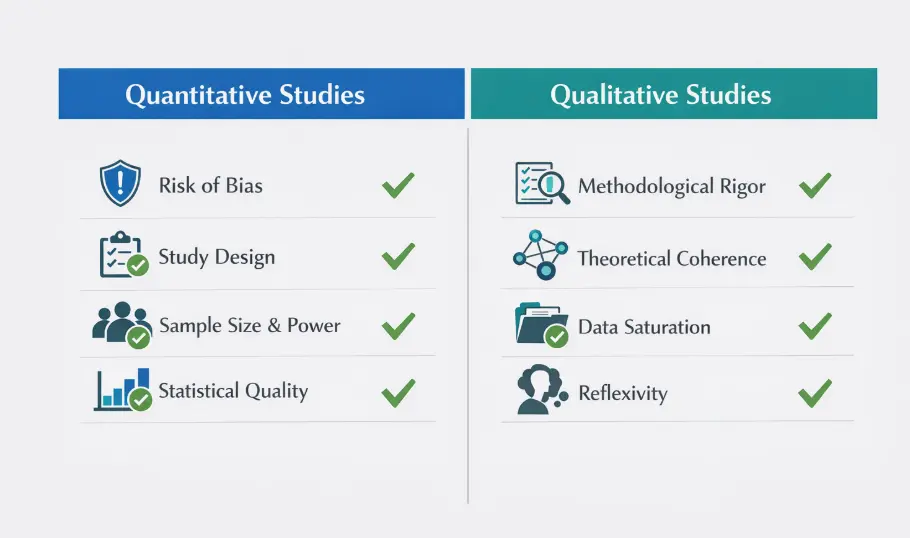
For quantitative research, assessment focuses on several dimensions. Use tools like Cochrane RoB 2 for risk of bias assessment that reveals potential problems in how studies were designed. Evaluate whether the study design actually matches the research question. Examine sample size and power calculations that show whether the study could actually detect effects if they exist. Assess the quality of statistical analysis that supports the conclusions.
Qualitative Studies
For qualitative research, evaluation looks different but is equally important. Use frameworks like CASP to assess methodological rigor. Evaluate theoretical coherence to ensure the interpretation flows logically from the data. Check whether the study reached data saturation where new data no longer reveals new insights. Examine reflexivity—whether researchers acknowledged their own positioning and potential biases.
Technology and Tools
AI-Powered Research Tools
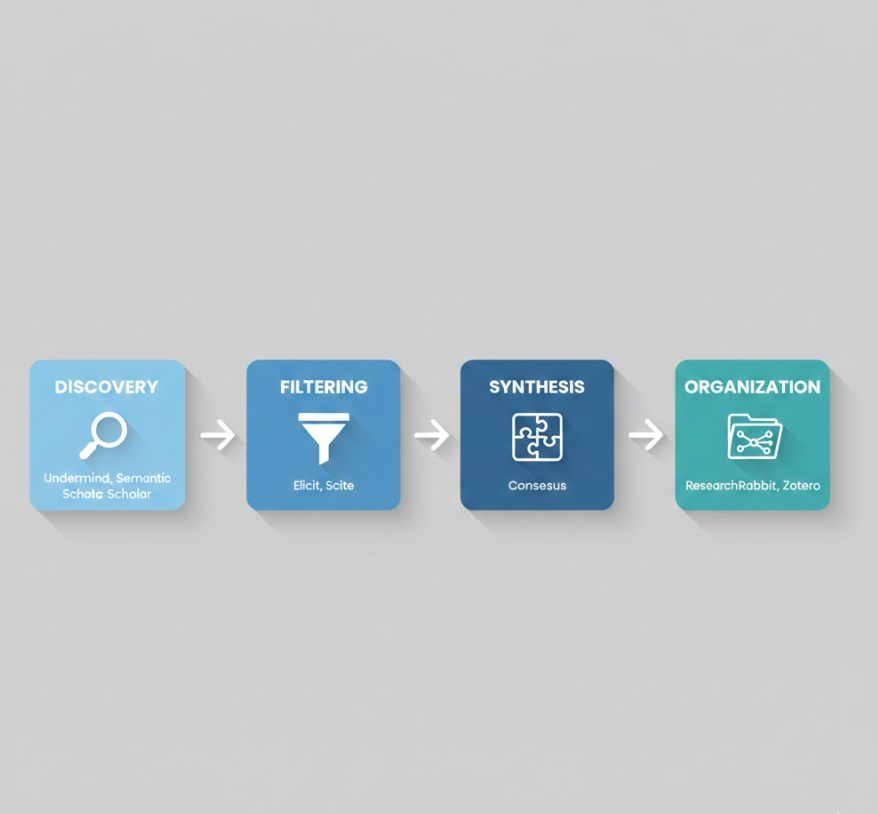
Modern literature reviews increasingly benefit from AI assistance that handles routine tasks. Automated screening tools help prioritize papers for your review based on relevance. Concept extraction algorithms identify key themes across papers without manual reading. Citation analysis tools map research networks showing how studies relate to each other. Synthesis support platforms help organize and connect your findings across many papers.
Workflow Management
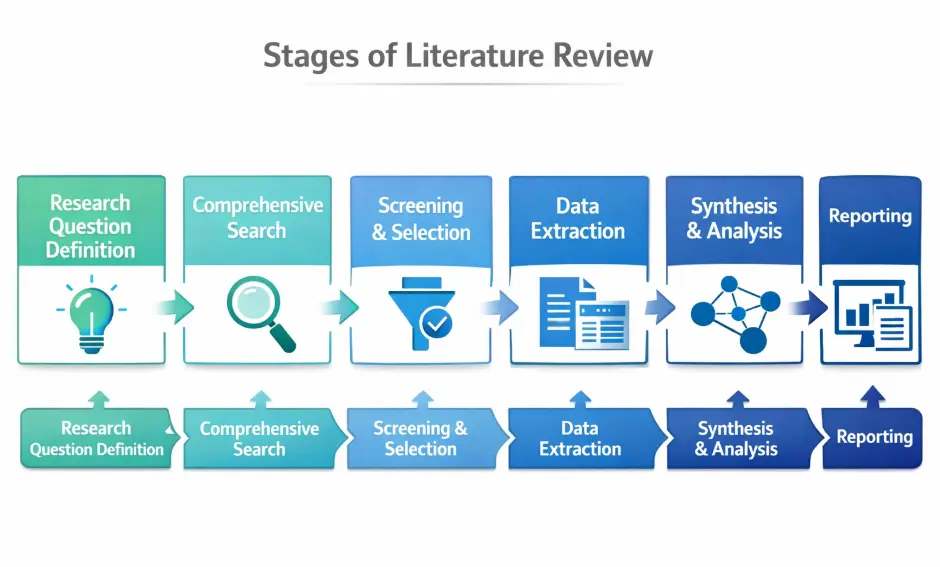
Establish systematic workflows that guide you from research question to final synthesis. The planning phase defines your scope and methodology. The search phase executes your comprehensive searches across databases. The screening phase applies your inclusion and exclusion criteria. The extraction phase systematically pulls data from included studies. The synthesis phase analyzes and interprets your findings. Finally, the reporting phase presents your results clearly to readers.
Common Pitfalls and Solutions
Search Strategy Issues
When searches are too narrow, relevant studies get missed from your final synthesis. Fix this by using multiple synonym variations and truncation to catch word variants. When searches are too broad, irrelevant results overwhelm you with noise. Address this by combining terms strategically and using database filters to reduce false positives.
Selection Bias
The biggest threat to your review’s credibility is cherry-picking studies that support your preconceptions. Prevent this through predetermined criteria that you establish before searching and independent screening from multiple reviewers who don’t know which studies you expect to find.
Synthesis Challenges
The information across dozens or hundreds of papers can feel overwhelming to synthesize into meaningful conclusions. Use systematic frameworks like thematic analysis to structure the process. Use visualization tools like concept maps or network diagrams to show relationships between findings.
Conclusion
Good reviews require systematic planning, comprehensive searching, and rigorous analysis. This investment pays dividends: you’ll understand new fields quickly, identify gaps, and position your work in the scholarly conversation.
Literature review is iterative. Your understanding deepens as you go. You’ll revisit and refine searches. Stay systematic but remain flexible enough to follow important leads.